


ProCat Solutions
Would you rent out your console when GTA 6 comes out?
Renting out a console by the hour while someone else plays on it over a stream. We looked at how it would work and why it gets stuck legally.

19 November 2026
Time left until GTA 6 launches
On PS5 and Xbox Series X|S. Rockstar has not announced a PC date yet. Source:Rockstar Newswire
Rockstar has set GTA 6 for November 19, 2026 on PS5 and Xbox Series X|S, and the hype around it is on a scale you rarely see. Plenty of people will buy a new console for it, and plenty will not, because it is expensive or because they want to try it before deciding. Between those two groups sits an obvious business idea: whoever has the machine at home rents it out for the hours they are not using it, and the renter plays on it over a stream from their own laptop, TV or phone. The owner earns money, the renter plays for less, the platform takes a commission. We looked at how it would work and where it hits a wall.
On the day itself, a lot of offices will see a strange spike in illness. Based on a US survey, roughly 1.5 million workers may call in sick or take the day off on November 19, and the estimates mention about a billion dollars in lost productivity. The economists Fortune asked think that is probably overstated, and that the economy would cope even if it were not. In the UK the estimate is 2.5 million absences, so this is not just an American thing. If half the team wakes up with a fever on the morning of November 19, it may not be the flu. And whoever does have to go in, or has no console of their own, could use a rented one in the evening.
How it would work
The owner registers the console, sets the time slots when it is available and states their upload bandwidth. The renter picks from machines close to them on a map or list, because distance decides the experience: once latency climbs past a few tens of milliseconds, a fast action scene starts to feel sluggish. After booking, the platform holds the fee in escrow, the renter connects, the session is metered by the minute, and at the end the owner is paid minus the commission.
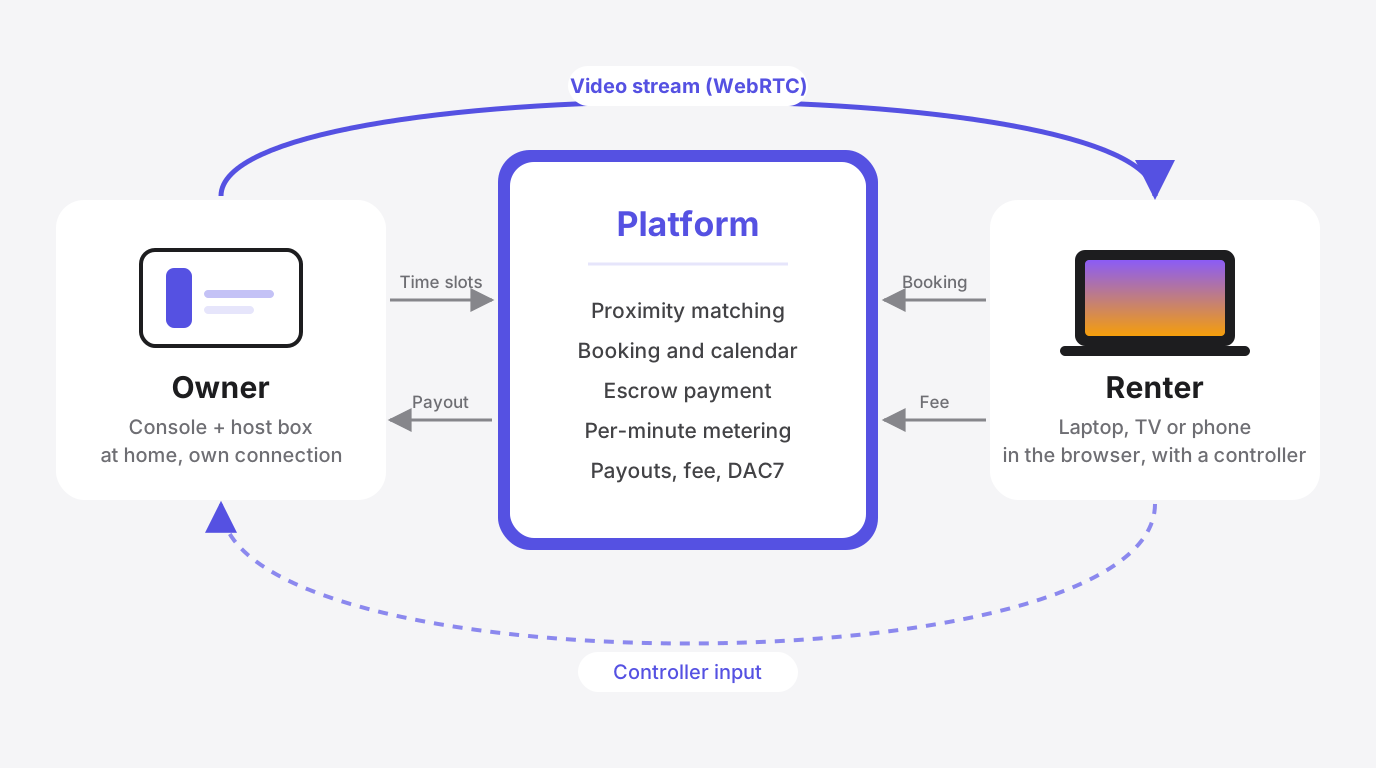
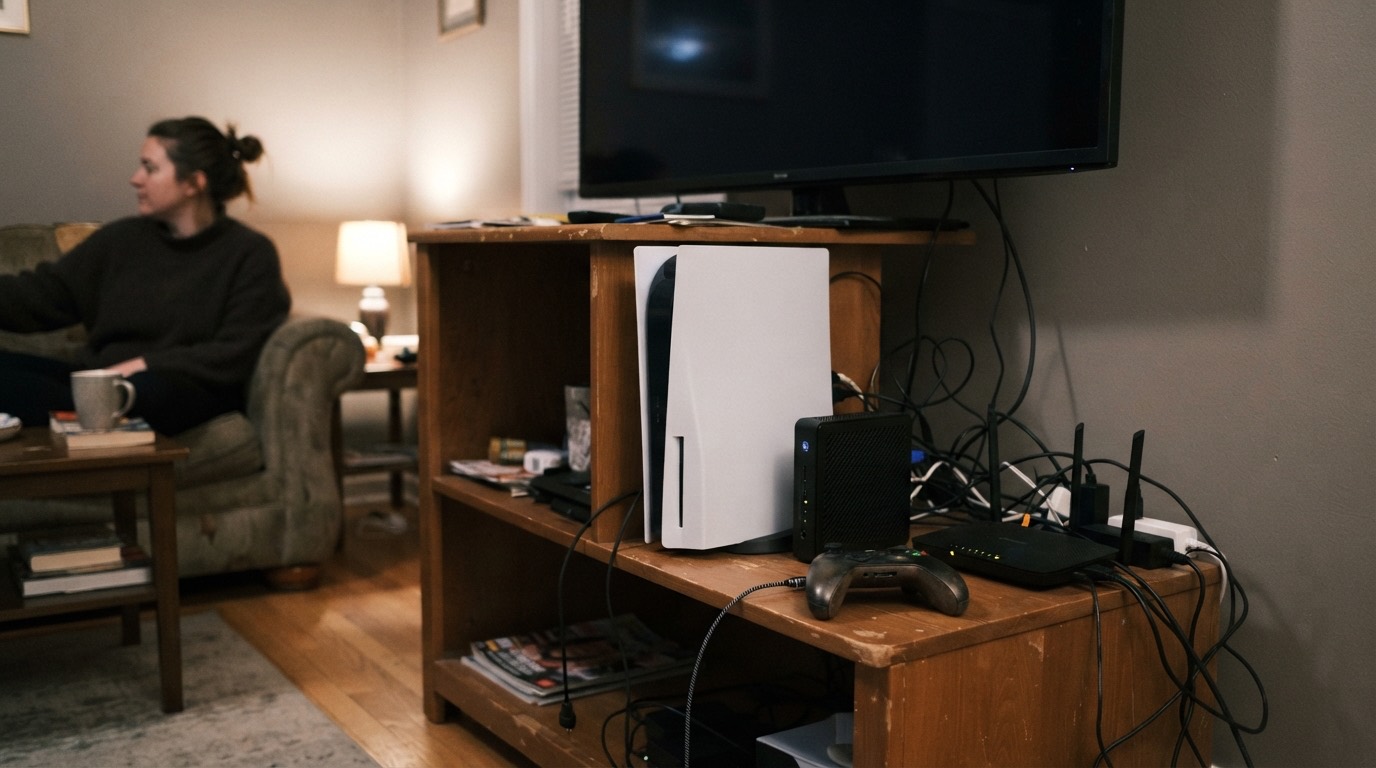
Technically there are two routes. One is the console makers’ own remote play feature, where the renter connects with the official app. The other is a small “host box” next to the console: a capture card, a mini PC, controller emulation and a WebRTC stream to the browser. The first is simpler but not ours to control; the second is fully in our hands, but every owner needs hardware shipped to them.
The platform itself is a classic two-sided marketplace: profiles, a booking calendar, proximity matching, escrow payments, payouts to owners, ratings, dispute handling. We have built all of these before, in other contexts.
Where it gets stuck legally
This is the uncomfortable part, and it is not worth playing down.
- Console platform terms. The terms of the big console online services typically cover personal, non-commercial use. Renting out a machine’s time for money conflicts with that, and the consequence can be a suspended owner account, purchased games included.
- The game licence. We do not own a game, we get a licence to use it. Publishers’ licence terms usually prohibit commercial exploitation and rental, and under the EU Software Directive renting out a program also requires the rightholder’s authorisation.
- Account sharing. If the renter plays on the owner’s account, it is a security nightmare: passwords, saves, purchases, bans for cheating. Logging in with their own account is cleaner, but the commercial-use question remains.
- Tax and platform obligations. Owners’ earnings are income, and under the EU DAC7 rules the platform has to report sellers’ revenue. This has to be handled from day one, not later.
This is not legal advice. Launching a product like this needs a specialist lawyer’s opinion first.
What can actually be built
So the question is not whether the technology can be built, but which business model holds up legally. We see three directions.
- Licensed partnership. An agreement with the publisher or platform is the only fully clean route. Hard for a blockbuster, realistic with independent publishers looking for new audiences.
- Own account, own licence, rented hardware time. The renter logs in with their own account and their own purchased game; the owner only provides the machine and the bandwidth. That takes game rental out of the picture, but not the commercial-use risk, which needs mapping with lawyers in advance.
- A physical venue. A console gaming room charged by the hour, where hardware and licences are our responsibility. Less scalable, but a long-standing, well-understood model.
If someone took this idea seriously, we would start with a mix of the second and first options: a narrow pilot, legally reviewed in advance, with a few independent titles and own-account login, and GTA 6 would only come onto the platform with an agreement from the rightholder.
How the business side would work
If the legal question is settled, this is what decides whether the platform survives. Everything below assumes the own-account, rented-hardware-time model.
Pre-booking launch night. Demand will peak in launch week, between six and midnight. That is worth selling in advance: whoever books a slot weeks ahead gets a discount on the later price, say 15 to 20 percent. Owners see their earnings up front, and before launch the platform already knows which cities are short of consoles.
Pricing. Owners set their hourly rate and the platform suggests one based on local prices and demand. Evenings, weekends and launch week cost more; daytime costs less. Renters can buy hour packs (5, 10, 20 hours) at a discount, or a monthly pass if they play regularly but do not want to buy a console.
Payment and cancellation. The fee is held on the card at booking, and the owner only receives it for time actually played, minus the commission. Cancelling up to 24 hours before is free; after that a partial fee applies. If the connection drops on the owner’s side, the renter is refunded the lost minutes automatically. Owners are paid weekly through a marketplace payment system (Stripe Connect or similar), which also keeps identity checks and the data needed for DAC7 in one place.
Rewards. Every hour played earns points to spend on the next booking. In the referral programme both sides get credit: whoever brings in a new renter or owner, and the person they brought. Reliable owners (stable connection, good ratings, keeping to their availability) get a badge and rank higher in search. Gift vouchers work too: an evening of GTA as a birthday present.
For owners. A calendar, pricing, a bandwidth test, an earnings report, and one button to stop renting instantly if they want to play themselves. At sign-up they already see an estimate of what the console could earn with 10 to 20 rented hours a week.
What it would cost to build
Building a platform like this is roughly a mid-sized SaaS project: a user web app and mobile app, an admin for owners, a superadmin for the operator, marketplace payments and payouts, real-time streaming and matching. You can estimate the order of magnitude in our SaaS platform calculator: switch on the marketplace, real-time features and mobile app modules. The cost of the legal review is not included; plan it separately at the start of the project.